Showing posts with label homeschooling saves you money. Show all posts

Saturday, February 4, 2012

5 Ways to Homeschool For FREE

Nothing is truly free. Or is it?

Today, while the economy is falling apart around us we need to rethink our priorities and allow room for some much needed deliberation. Everyone seems to be on the government dole but, if you're like me, you are constantly looking for ways to keep your homeschool humming along without sponging off the taxpayers or breaking your piggy bank. The following are a few ideas we found helpful and succeeded in keeping us out of the poor house.

1. Library card. Nearly every town and city in America has a public free library. Register for a free membership card and you'll have access to all the age appropriate books, magazines, videos and internet service you'll ever need.

2. Freecycle and dumpster diving. Freecycle is an online organization with members who run local chapters. Find the one nearest you, sign up and start receiving offers for a plethora of free stuff. The only drawback is you'll need to go pick the items up. A day at the local dump can net you some freebies too and it isn't always junk.

3. Tag sales and estate sales. Look for the seller's free piles. The early bird may get the worm but sometimes it's better to wait it out. Go to a tag sale or estate sale later in the day when the seller is ready to just give it away. By the end of the sale some of these free piles can be huge with gently used brand name items and tons of books or clothing!

4. Family and friends. Once family and friends learn you're educating your own children they eventually start talking your homeschooling language. Many are willing to pitch in and their gift giving and thoughtfulness becomes much more educationally oriented. Family and friends can also be mentors.

5. Imagination and creativity. Of all the ways to homeschool for free this is probably the most important. Einstein once said: "Imagination is more important than knowledge. For knowledge is limited to all we now know and understand, while imagination embraces the entire world, and all there ever will be to know and understand." Cultivate your imagination and use it. Don't overload yourself or your children with busy work. Focus on reading, writing, arithmetic and U.S. Constitution. That includes your own academic skills too. All things will branch out from there and fall into place.

Now, go forth and prowl the world as a proud freegan!


Connect with Guerrilla Homeschooling on Facebook!

Wednesday, January 25, 2012

The 3 best books to help you stop living paycheck to paycheck

Tired of living paycheck to paycheck? Can't quite get a handle on those personal finances? So many of us think we learned all we needed to know about money in school but the truth is we were simply taught how to be good consumers. Were you told to get good grades so you could get a good job once you graduated? Has anyone asked for your report card since then? Do you know what a financial statement is? Well, a financial statement is your report card in the real world. Looking back I cringe to think of all the time and money I wasted before learning the facts about money.

Not until I began teaching personal finance to our own children did I learn the truth about money. After countless hours of reading and research I am able to narrow my recommended reading list of financial books to the following three: Rich Dad, Poor Dad and Increase Your Financial IQ by Robert Kiyosaki and The Laws of Success in 16 Lessons by Napoleon Hill. 

Kiyosaki will teach you the difference between poor people and rich people in easy to understand terms. In his books you learn how to write and read a simple financial statement, your report card for the real world. Forget everything you ever learned in business and accounting classes because Kiyosaki turns everything you ever learned on its head. Both books are an easy read but very enlightening.

Napoleon Hill was hired by Andrew Carnegie in the early 1900's to observe the wealthiest men in America for 20 years. Hill published his findings in 1928. This book is out of print but can be obtained online for free or you can buy a copy on CD at eBay. Not only will you learn about finance but also how to generally succeed in life. Once Hill's book was published it caused an uproar within the circle of those interviewed so Hill published a watered down version ten years later titled Think & Grow Rich. If you want the full effect of his findings you need to read the original book.

These are not get rich quick books. Building wealth and getting out of ridiculous debt takes time. Use these books in your homeschool as building blocks to financial freedom. Many of us are concerned with the present economy in this country. Those depending on the government coming to their rescue are in for a frightening surprise when they realize there is nothing left in the coffers. Learn the difference between assets and liabilities. Learn how building a business can make you wealthy. Learn to invest. Learn to be financially free and be able to sleep at night knowing you can help your children have a better and brighter future.


Connect with Guerrilla Homeschooling on Facebook!

Friday, June 10, 2011

The Most Taxed States in the U.S. | Taxes | Money/Investing | Mainstreet

The Most Taxed States in the U.S. | Taxes | Money/Investing | Mainstreet

Guess which state is #1. Yup! Vermont!

"There is both a school property tax and a municipal property tax for personal property and a statewide education tax imposed on all nonresidential property at a rate of $1.35 for every $100 of the assessed value."

Meanwhile, 72% of our public schools are failing.

Time for all those in this state collecting welfare and food stamps to thank a working Vermonter for their handouts. I'll be checking my mail for those thank you cards beginning tomorrow morning.

Connect with me on Facebook!

Sunday, May 15, 2011

Is college putting you and your child in the poor house?


Gerald Celente is great (as always) in this documentary. Kudos to National Inflation Association for a job well done!

It's amazing to think I lived the college experience but fortunately for me I didn't go into debt nor did my parents for doing it. Granted I managed to go to college on the GI Bill but millions of young people go into hock these days to buy a college degree. A degree that doesn't guarantee employment or even an education of any value. Out of the five official years I spent on campus purchasing a degree my best college lessons were from only two professors. Of those two professors one was a commercial artist and the other was a theater director. Both pushed me to excel in whatever I chose to pursue simply because they saw I had the self-discipline, initiative and maturity to do so.

By the time I landed on campus I had already been in the US Army, traveled the country, had worked full time for several years and was much older than my classmates who were fresh out of high school. My upbringing may have played a role too since I grew up in the 1950's and 1960's with 10 siblings on a farm where we needed to be self-sufficient and industrious in order to survive.  Our grade school consisted of two rooms with grades 1-6, about 50 students total. Back then the only two teachers in that school made sure we learned reading, writing and arithmetic. We learned to socialize with other children on the 2 mile walk to and from school and on the playground during recess. When I got to high school much of what was 'taught' didn't make sense in the real world and seemed like useless information even back then.

When we decided to homeschool we made the conscious decision to pick and choose any formal courses our children might attend. ANY public school attendance was completely taken out of the equation. We were not about to give the public school system the slightest opportunity to take credit for even a fraction of our child's education. We proved public school was unnecessary and a waste of tax payer money. Community college was used but only as an alternative to high school and we paid out of pocket per class. College courses were highly focused and our children are not indebted to any bank, loan company or the taxpayers.


Connect with me on Facebook!

Saturday, January 29, 2011

Homeschool Freedom Act Introduced in New Hampshire

Homeschool Freedom Act Introduced in New Hampshire

"The proposed law involves homeschoolers sending a simple one-time notification when a homeschool program begins. The bill also removes several provisions which granted state agencies unnecessary oversight and created unwarranted bureaucracy for school districts and parents. Numerous states have changed their laws in recent years along the same lines as H.B. 301, including Arizona and Nevada, because national homeschooling research has shown that needless bureaucracy just wastes parents’ time and taxpayers’ money."

Let's hope the rest of this country will begin to follow this lead. In some states it's amazingly simple to homeschool. In other states it's a bureaucratic nightmare. Homeschooling is catching on like wild fire and folks are realizing its massive savings to taxpayers, let alone the fact that the education homeschoolers receive far exceeds that of public schooling.

We're in tough economic times. Homeschooling may be the saving grace this country needs right now for more reasons than just saving the taxpayers money.

The new law may or may not help this persecuted homeschooling New Hampshire mom.

Connect with me on Facebook!

Monday, November 29, 2010

Combining work and homeschooling is easier than you think

Do you work and want to homeschool your children but don't know how to do both? Here is a great article at Business44.com with some helpful tips on how to work AND homeschool your children at the same time.

Over the years we managed to work out that problem for ourselves by first deciding I would stay home with the children while my sweet hubby worked outside the home. From there I managed to establish several home-based businesses to make more income and to teach our children how to create home-based businesses of their own. We did everything from flea markets to publishing but our main source for the most reliable home-based income turned out to be eBay! These days my hubby still  commutes 100 miles a day round trip to his job but my commute consists of a walk down the hall to the eBay room and out to the mail box to ship what we sell.

The benefits to working from home while homeschooling your children are endless. Now that our children are older I treasure the time spent with them while they were growing up. I fondly remember the teamwork effort we all put in to survive and thrive. Our children are now both happily employed and have never been on unemployment assistance. Neither have my husband or I even during all these years of working. We taught our children there is a difference between having an income and having a job. There has always been a way to make an income for our family and our homeschooling no matter how large or small. You just need to get creative and be willing to work at it.

Learn to manage your priorities NOT your time. You cannot manage time but you do have control over your goals and priorities. Become financially literate as well. Talk to other homeschooling families to get some ideas for home-based businesses and find out how they solved the problem of combining work and homeschooling. I know a single mom who worked three jobs and still homeschooled her son. By the time he turned 18 he had nearly 30 college credits and was accepted into the U.S. Army without a high school diploma, high school transcripts or SAT scores. If she can do it so can you!

Connect with me on Facebook!

Saturday, November 6, 2010

Homeschooling – The Costs

Homeschooling – The Costs

Again, homeschooling only need cost as much or as little as you're willing to spend. The reality for many families is that homeschooling is simply an extension of day to day living. Most families already have a house full of books, learning materials and comfortable furniture. There is no need to purchase 'school' materials or furniture.

It is mentioned that some homeschooling families have a mom with a college degree but she has given up the opportunity to make money outside the home. When a family actually calculates what the cost of working outside the home is most will find the added income, after taxes and expenses, is minimal or at a break even point. You can't put a price on the value of a mom staying home with her children for the first 18 years of their lives. Being a mom (and a stay-at-home mom) is already a full time job that needs our complete attention.

The key approach to homeschooling is to RELAX. Sometimes the best learning tools are the simplest objects around the house and not the latest plastic gizmo or electronic gadget. Some of your child's best teachers will be grandma, grandpa, mom, dad, sister and brother. Save your money for more important things like that special family trip to Disney or a good used van for free field trips around your neighborhood with family and friends. Life is actually simple. Try to keep it that way.

Thursday, July 8, 2010

Are school trappings and froufrou needlessly costing you money?

Recently I stumbled across this little article concerning financing your homeschool. Geeeeesh, if this isn't enough to scare you away from deciding to homeschool I don't know what is.

The author writes: "When you need to make sure that your children receives state-of-the-art education so that they can compete with regular school goers, expenses will naturally mount."

What exactly IS a "state-of-the-art" education and since when do "regular" school goers get such a thing in public school? Most public school graduates I've met can barely read and write beyond a present day 8th grade level. Gee, I didn't realize public schooling was meant to be a competition. Personally, I don't want my unschoolers to compete with anyone. I want them to be self-sufficient and leaders within their own community and businesses.

The author also writes: "The actual cost of educating a child at home is surprisingly high. Up-to-date textbooks, course materials, a library, computing equipment, lighting, specially designed furniture all cost money."

One of the first things we learned 23 years ago as newbie homeschoolers was how unnecessary textbooks, course materials, specially designed furniture, school trappings and froufrou were to the success of our child's education. We quickly canned the desks, textbooks, curricula, tests, grades, school room and anything remotely associated with schooling. We simply began to live our lives on a day-to-day basis and did what we could afford to do, not what was expected of us by outside prying and schooled eyes. Also, the last time I checked a library card was free!

Home education is only as expensive as you want it to be. You have total control of your finances and budget. If you do need extra financing for your homeschool you can get some ideas at this link.

Don't feel pressured into thinking your child needs to attend every available opportunity and lesson to become a well rounded, intelligent, caring person. An overload of dance lessons, karate lessons, sports, summer camp and tons of other outside-the-home activities will not only be costly but may also burnout both parent and child. Relax and take life as it comes!

Monday, March 8, 2010

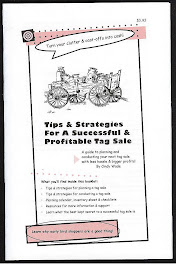
FREE online Tag Sale Guide now available to Guerrilla Homeschooling blog readers!

Tag sale season is fast approaching. Having your own tag sale is a great way to raise funds for your homeschooling family. Turn your cast-offs and clutter into cash!

As a special thank you to all my Guerrilla Homeschooling blog readers I am making my tag sale guide Tips & Strategies For A Successful & Profitable Tag Sale: A guide to planning and conducting your next tag sale with less hassle & bigger profits! available online for FREE! Just go to the top tabs at my Anna Q's Attic blog and click on Free Tag Sale Guide! You can read it online or print it out for your own personal viewing.

*Note: This online eBook version of the Tips & Strategies For A Successful & Profitable Tag Sale does NOT contain the Tag Sale Calendar Time Line. In the printed version this time line is a center page pull-out feature.

Thursday, March 4, 2010

10 Ways to Pay For Your Homeschooling

1. Quit your job! That’s right. If you are a two-parent family and you both work outside the home, one of you needs to quit your job. Just think of the savings. No more need to maintain a second vehicle, no work wardrobe, lunches, gifts for fellow employees, travel expenses, day care, housekeeper and so forth. Go home, get to know your children and heal your splintered family. If you’re a single parent family this may not be so easy but it can be done. Assuming a truly single parent has lost a spouse the divorced single parent usually has some sort of financial child support. If this is the case you’re still operating as a two-parent family and this suggestion still applies.

2. Create a home-based business. Now that you’ve quit your outside job you can work from home. Get your children involved and give them responsibilities. Little ones can empty the trash can or dust the office. Older children can learn computer and marketing skills. This is a great way for them to learn economics, math, business law, bookkeeping, accounting and more. You’ll be amazed how many tax deductions are available for a business owner.

3. Sell on eBay. If you sell on eBay you will never be unemployed. Like most families you probably have lots of items around the house that no longer have any use or value to you. Set up an eBay seller account and start listing. You’ll need a scale and a measure tape. A camera isn’t necessary if you’re listing books with ISBN numbers because eBay will usually supply a stock photo. A digital camera is handy for providing photos of your other items though. The post office will supply free shipping materials if you use the Priority Mail service. However, there are lots of sources for free used boxes for shipping. You may need to buy a ready supply of clear packing tape and printer paper. Learning eBay is easy because it’s mostly multiple choice, it’s safe and the business systems are already in place.

4. Start a Barter Club. Make a list of what you need or want, gather some trustworthy friends and relatives, and start cleaning out your overstock of books, educational materials, clothing, toys, homegrown food and items your children have outgrown. You can have regular meetups or simply distribute lists to those in your group. Be sure to add condition, age range and quantity. Items need not be homeschool related or seasonal. 

5. Create a blog and monetize it. There are many free blogs websites online but I recommend Blogger.com because it’s free, easy to use and has lots of great features to spruce up your blog. Once you set up your blog you can monetize it. This means you can add products, ads and even donation buttons to make money. Just remember you’ll need good content to drive traffic to your blog and if you do, it can be quite profitable. It’s also a great way to document your homeschool because a blog is like a public journal. That digital camera you acquired for eBay will be handy for adding photos to your blog.

6. Do odd jobs and get paid. There are many folks in your neighborhood whom could use an extra hand at leaf raking, snow shoveling, dog washing, garden weeding, grocery shopping, goat milking, housekeeping, garage cleaning, and more. Make business cards and flyers to hand out to family and friends to advertise. There are many websites that offer free business cards if you pay the shipping. I use VistaPrint.com and order my cards through BigCrumbs. I get the cards for free, pay the shipping and get cash back on the shipping fee.

7. Create a product. Take photos and sell them. Write a booklet or e-book and sell it online. Make a craft item and sell it on eBay or Etsy.com. If you upload your photos or drawings to a print-on-demand website like Cafepress.com you can have your designs printed on T-shirts, mugs, calendars, note cards and much more for free. When the item sells you get a commission.

8. Buy and sell junk. Indoor and outdoor flea markets are a great place to sell your cast-offs. If weather allows you can always have your own tag/garage sale. Go to tag sales later in the day when the sellers are ready to give their items away cheap or have made free piles. Auctions are a great place to get a van load of goodies for very little cash. Just remember to leave room in your van for the kids when you shop at an auction. We sometimes returned from the dump with more than we took because the pickings were good that day. Take your new-found treasures and sell them on eBay.

9. Team up with other homeschoolers. Buy in bulk, barter, trade, borrow and share. This could be everything from books to your precious time. Take turns driving to lessons or child sitting. Swap books and homeschooling supplies. As our children grew we had many computer CD’s we passed along to younger or new homeschoolers. Last time I checked the public library was still free. If you have a library card and a computer you have the world at your fingertips. Once grandparents and family members realize you’re serious about this homeschool thing they tend to get into the spirit by giving more support and educational gifts on those special occasions like birthdays and holidays.

10. Create a budget and follow it. This is very important. Learn where your money goes and it will be easier to manage it and make it last. Prioritize! Distinguish between want and need. Once you do this you’ll be amazed at how much found money you have for those little extras. The Rich Dad Poor Dad series by Robert Kiyosaki has some great books on personal finance and understanding money. Kiyosaki also has a fun website for children where they can learn about money. If you can’t afford to buy these books you can always borrow from your local library or a friend.

Learn to buy and sell junk...one man's trash is another man's treasure

Connect with me on Facebook!

Wednesday, March 3, 2010

Homeschool News – 7 Shocking Facts About Home-Based Education

Homeschool News – 7 Shocking Facts About Home-Based Education

Well, the voters (some of them at least) passed all the school budgets in our town yesterday but here is a reality check for them...

"Fact #6: Spending more per student via public culture does not improve performance. Homeschool culture generally costs $500 per student each year for curriculum and equipment, while public culture costs an average of near $10,000. Regardless of total dollars per student, homeschool students came in at 86-89% performance, or 36-39% above the national public school average."

Kudos to homeschoolers for not adding to the taxpayer's burden!